Sunday, November 15, 2009
"Water Walk" Composistion (January 1960)
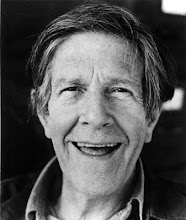
At the time of performing this magnificent piece, John Cage was teaching Expierimental Composistion at New York City's New School and was without a doubt one of the biggest controversial music composers in his time. Hes is greatly known for his philosophies and expierimentations with sound and to me is just a beautiful being with a passion for testing the limitations and possibilities of sound.
When I first viewed this video of Cage performing "Water Walk'', as he went through the long list of "instruments" ranging from a water pitcher, a bathtub, piano,iron pipe, bottle of wine, ice cubes, 5 radios and many more that were going to be used in his composistion, I was at first shocked and kind of doubtful o f what this was going to turn out to sound like and whether this was going to even remotely relate to what i refer to as music. When I think of music i think melody, rythym, tempo, chorus, on key, smooth flowing transistions and a theme. At first I felt that "Water Walks" lacked all of these and was simply just a slob of random noises and disjunctioned sounds lapping eachother for three minutes. But as i viewed it the next few time I slowly began to understand where Cage was coming from. Now just like what i do in a fashion with my progressive/minimal electronic music productions, I mix and tweak parameters of various sounds varying all over from synth high hats, deep soft pads, ambient lifting leads, world drums, grinding syncipated oscillators and various other digitally composed and engineered sounds that mimic such familiar sounds. i.e. cowbell,tapping on a glass bottle, door knock etc., Cage was applying the same basics. Only his is a more primitive technique. I kind of saw his act like the worlds first DJ performance.
Cage remains on a choreographed time with his stopwatch in his piece and initiates sound at no given random time but on a scheduled exact moment that he planned. So no sound initiated is accidental. So to a certain degree there is a element of order and song architecture in his work, its just a very minimal but sufficent use of this key characteristic that defines what music is.
In this work i also noted that the objects he was using were all "found objects" or "readymade" objects or average things that you or I would have been familiar with in those days. This of course immeadiately linked my thoughts to the dada time period in visual art such as Robert Roshenbergs monogram assemblage which was compiled of various found objects including a goat,tire, and a painting.
So, in whole I believe Cage was demonstrating a primitive form of sound mixing and expierimentation and combing his values of conceptual art with sound and just pushing the boundaries of music.This piece soley, greatly influenced the world of music that we hear today. His expierimentation of the simple readymade sounds in this piece are the brilliant pioneering efforts that I believe are taken for granted in music that is so widely popular in all genres of music that we hear today.

Subscribe to:
Post Comments (Atom)
No comments:
Post a Comment